


Nomadic Life, Crazy UK Politics. Goodbye Blackfordby, Seed Co, Tanganda, Meatmart, and Acacia Holdings
- May 29
- 8 min read

Last week, I calmly asked my son, Selby, to help with an issue with this old computer and, with me being patient, we got through it without me raising my voice in anger at the dumb machine or, eventually, him. A good lesson to take forward. Stay calm. Rozanne reprimanded me today for telling my sister Fiona and her partner Gordon Foster, who live in Scotland, that I cannot understand how the younger generation can just up sticks and work anywhere in the world with no fixed abode. I know I am repeating myself, and therefore I am not going to make the paragraph too long, other than to say, on talking to our good friend Dave Clements by means of text, that he has completed three new houses on his property, and one of the target markets is to rent them to digital nomads, writers or artists, that is people who want more than a few days stay, rather six months plus in one place in secluded and quiet surroundings. I say secluded as he lives on the banks of Lake Mutirikwi in Zimbabwe. So there you are, they, nomadic workers have even reached Zimbabwe, never mind Spain, Portugal and the far east, which I considered their favoured working areas.
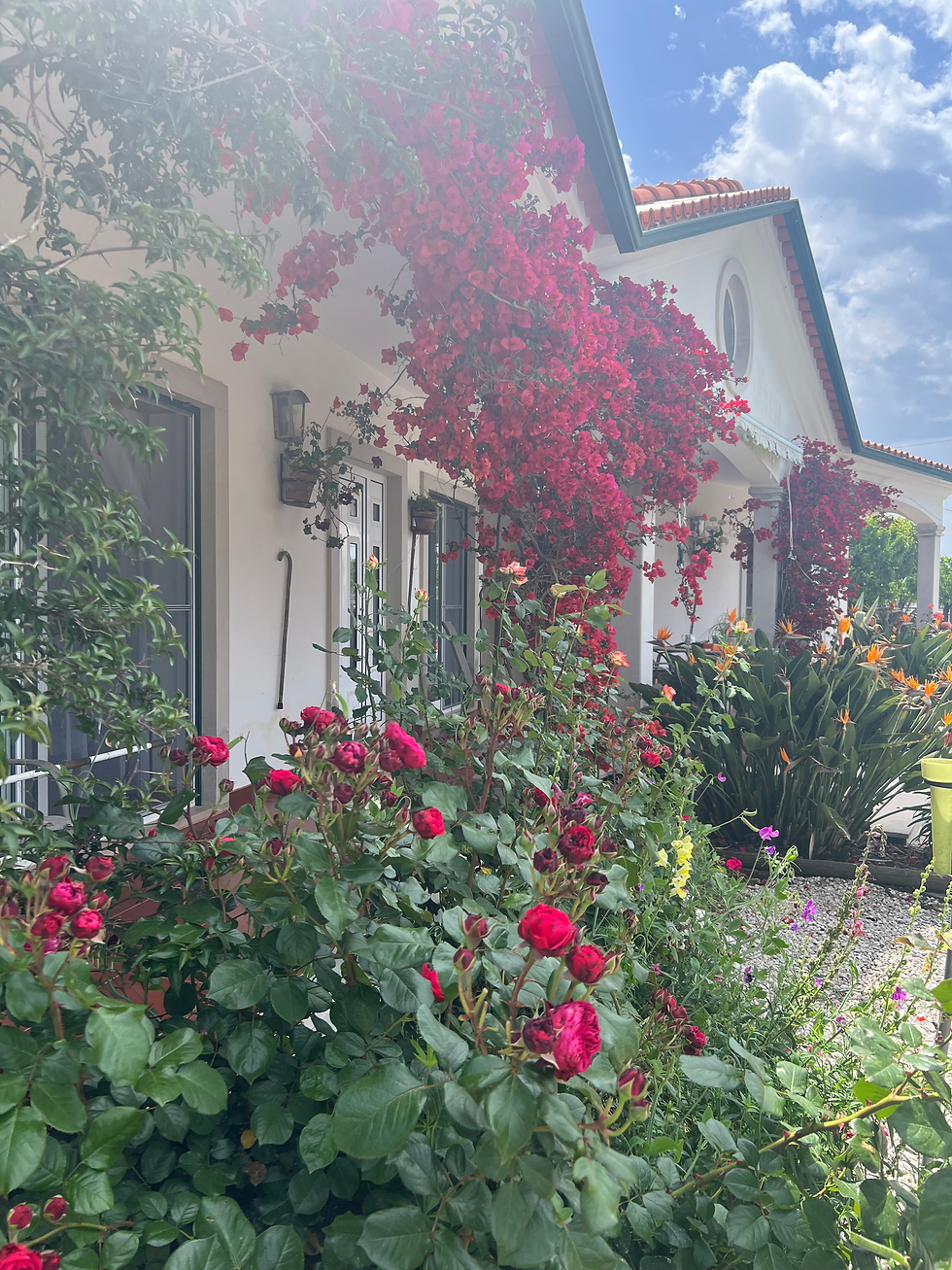
“Is it possible that the brightest of this world will in the future cut all ties with their places of birth, maybe the word is origin, and therefore hold no allegiance to any nation, be it birth or present place of residence?” - Peter McSporran
I say this because I no longer feel an allegiance to Scotland, my country of birth, nor now to Zimbabwe. Oh yes, I have nostalgia for both, much more so for Zimbabwe. I suppose the closest I have to any loyalty now is to the South African rugby team, which I support along with the provincial teams in the URC against European teams, and to Portugal as a country, which has been very welcoming and, despite my ill health, kind to us. That is why we are happy to pay tax here and hope to live out our years here. Funnily enough, many of the expats who come here in their old age, determined to live out their life here, return to their home countries, especially on the loss of a spouse or ill health. By the way, Selby and Maggie are busy trying to find a suitable country to set up a home, raise children, and work from outside the UK, although his company is based in the UK. They cannot stand the British weather, and perhaps British politicians, but I daren't talk about that as I have such strong personal opinions about what is going on in the UK, north and south of the border. I did ask whether they followed British politics, and it was no surprise that Rozanne and I seemed to have better knowledge of the political sculldurrgery going on in the UK. I think they feel they can do nothing about it, and best to just move.
My favourite politician in the UK at present is Kemi Badenoch, a British-Nigerian with a Scottish-sounding name. I can't say yet whether she would be a good PM, but she is an articulate and savvy opposition leader who has the measure of Starmer. In the meantime, the wealthy and the bright are fleeing Mud Island in search of stability, lower taxes, and just some good common sense.
“It is a strange world we live in. If you work hard, save, own your own house and are happy to show your allegiance to Britain, you are demonised as being far-right-wing agitators. If you are lazy, have an aversion to work, live on benefits, and squander your (the state's) money on beer and the horses, you need to be protected. The more radical you are in your left-wing views, the more progressive you become.”- Peter McSporran
I ask you, when does lowering the VAT on fairground rides and zoo entry improve the cost of living? It did not take long for some bright spark to work out that, in fact, a family outing to a funfair would cost a family roughly £200. Remember, only the rides are subject to lower VAT; therefore, on that bill, the saving would be only a paltry £1.64. Then they considered price controls on basics in the supermarkets, yes, eggs, milk and bread. Do they know that dairy farmers and cereal producers are not covering their costs? It is bad enough to think our politicians are stupid, but it is easy to presume their advisers are equally so. Why should we think that buying Russian fuel variants will save gas emissions in the UK more than using our own in the North Sea? It's not cheaper, but it creates jobs in an area that needs them and the technical services that supply them throughout the UK. It cannot be for climate change, as whatever the source, the emissions are the same; the same cannot be said for its production and transport from foreign lands. Enough said.

Then again, the fibs (downright lies) being told North of the border in Scotland are beyond the belief of a law-abiding citizen. The hierarchy denied any knowledge of the shenanigans in the SNP accounts, despite the fact that, at the time, everyone said they did, claiming that no money was missing. This includes the previous First Minister, who, while in power, said she knew everything, controlled everything and was responsible for everything, she had her hands on the pulse of the country, but despite this, she was not observant enough to notice a Jaguar in her driveway, nor a camper van in her husbands parents driveway or did wonder where the expensive necklace around her neck came from let alone the Mount Blanc pen she uses every day. I wrote this paragraph as one of the best insults to the Murrells (Surgeons) was the one written by Magdalene Grant in the Spectator Magazine this week. It reads:
‘All of it has echoes of one of those corrupt African dictatorships, where the wives of Generalissimos would clear out Harrods while the World Food Programme intervened on the ground. Murrell’s fate is sealed as a tartan Grace Mugabe’- Spectator Magazine
Even in this fairly socialist country, Portugal, new tax breaks are being offered to stimulate housing construction, help young people buy homes, and increase the availability of rental properties. They are reducing IVA (VAT) from 23% to 6% on new builds, including those for rent, as well as on renovations. Lowering tax on rental income from 25% to 10% to attract more house owners to rent their properties or part thereof out to 3rd parties, and in the event that you sell your house and invest in a property for rent, you avoid capital gains tax and give tax deduction allowances up to €900 for tenants. Also, any property-related renovations can be deducted from the taxable income of that property for up to 3 years.
“Portugal is a country with a socialist Government that is more conservative than most in Northern Europe.”- Peter McSporran
This is the sort of thing needed to incentivise housebuilding in the UK. You would have thought the previous Conservative Government would have done something similar, let alone the present no-brain Labour Government. Rather, it is the opposite, by hitting landlords and homeowners with higher taxes and ridiculous rules. Oh, it is certainly not the Britain of old, so no wonder the rich, bright and young are leaving, only adding more long-term pain for those that remain. I am so glad I left all those years ago.
So late in 2002, I was not only forced to stop farming, but I was about to lose my means of generating an income, my business, and property, and, as I was going to permanently leave Zimbabwe, I felt I had to resign from the boards I served on for many years, both public companies and public services. I had been on the Seed Co-op and Seed Maize Co. board for in excess of some twelve years, and seen it grow from a farmer-owned co-op to a large blue-chip public company, the leading seedhouse in Southern and Central Africa, exporting in the region and even into East Africa. In fact, we had set up a subsidiary in Botswana to support our export drive, which we saw as the best way to expand the business. Now, with the farms under threat or already taken, its producer base, the backbone of the company, was being destroyed, and it was going to meet some hard times. The structure of the board had gradually changed since becoming a public company, from all farmers to now including some eminent business people from Harare. Before I left, I had supported the appointment of Dave Clements to take over Seed Co Zambia, the subsidiary in Zambia, which was floundering. At my last board meeting, I informed the board that Zambia could well become the leading seed producer and exporter in the region. Well, that went down like a lead balloon. I remember Pat Rooney, Brian Black, and Rob Davenport openly scoffing at the idea and even suggesting I was crazy to think so. I think the townie members and indigenous management members were happy I was leaving because of my being once an ex-CFU president; being positive was now a negative. My recent open, outspoken opposition to the government's actions on land had now, in their business eyes, become an embarrassment and a liability. Oh well, C'est la vie. Now, twenty years later, very much due to Dave Clements' dynamic management skills, Zambia now annually produces 178,000 tonnes, of which 88,000 tonnes are exported, against Zimbabwe’s meagre 38,000, all for the local market. Even the state president of Zambia turned out to see the first load of seed maize dispatched from Zambia to Zimbabwe. I am happy to have contributed, in a very small way, to that success.

The equally saddest resignation was from Blackfordby. I had been at the CFU when we were invited by the ZTA to participate in the new college at Blackfordby and expand the college into a general agricultural diploma course. I joined the board of management at that stage and, on standing down as president of the Commercial Farmers' Union (CFU), became the board chairman on Vic Hurley’s retirement, a real honour. We also ran numerous management and staff training courses and, over the past 8 years, gained a reputation as one of the premier agricultural colleges in Central and Southern Africa, with its graduates easily finding employment in management roles or returning to run the family farm. To get a farm tenant scheme loan, it was almost a prerequisite to have a Blackforby Diploma. It was also a much cheaper alternative to studying agriculture at Cirencester, Harper Adams, or a similar university or college in Europe or Canada, with practical training very much focused on Zimbabwean crops and climate. Such a sad day when I told Peter Richards, past president of the Zimbabwe Tobacco Association and the chairman of our Trustees and the director David Baxter, now deceased, that I was going. Blackforby, I mark as a very constructive and beneficial period of my contribution to the farming community. Now all gone, so sad.
With the ranchers losing their land, there would be no need for cattle financing, so Meatmart was wound down and, in doing so, cleared its books of both creditors and debtors, an achievement in those turbulent times. Acacia Holdings was also to go, a major tractor machinery and equipment supplier and finally Tanganda Tea, the board of which I really enjoyed as I did their lunches and wine at Meikles Hotel. The relationship between these two businesses has the descendants of the Meikles family as major shareholders. While serving on all these boards came with a lot of responsibility and time off my farms, they were excellent training experiences, not their intended purpose, for me to use in later life as the lead on investments and sitting on many boards from Africa to London. It was such a good life, work and social, both were very much intermixed, but now only a pleasant memory.



Comments