


Momentum, Dogs and Cats, and the Road to Sesheke.

I am not a fan of soccer, probably because I never had the coordination to keep the ball at my feet when dribbling. My younger brother Archie always wanted to play with a football when I came home from school for holidays, and even at half my age, he could beat me. Rugby was my game. Despite this, Rozanne and I decided to watch the England versus Argentina semi-final in the World Cup. By the first water break, I was bored, but at the same time my pain suddenly appeared, and I retreated to bed for the next hour, only to return following England's goal. Then two things happened: Argentina upped their attacking game, and, instead of maintaining their momentum, England went into defensive mode, even replacing attacking players with defenders. And sure enough, in losing their momentum, they lost the game. The same with rugby: when a team has the momentum, it can overcome many difficult challenges, but as soon as it lets the other team take the initiative, be it due to complacency or tiredness, the game will surely be lost. I only watched about forty minutes, and those were my thoughts. It is the same in business: if you have momentum and are expanding, you often succeed; if you slow down to preserve what you have, others will surely seize those opportunities on offer and your business will stagnate.
"In any team sport, momentum and endurance are the key factors. Good teams know this as do good businessmen. In business consolidation can quickly change to stagnation."- Peter McSporran
By the beginning of last week, I was not only having extended daily pain, but I felt continuously nauseous, and I thought perhaps it was the medication after looking at some of the medication's side effects. So I cut out the medicines related to my stomach issue; remember I had been prescribed over eighteen different medications in the medical fraternity’s efforts to find a cure, to no avail. Surprisingly, I had five days without pain until Saturday night when it returned. Last week I did not mention I had had a relatively pain-free week, as in the past I have had some days, as many as three, pain-free, but this was the longest and I did not want to raise my hopes too high. Anyway, on Saturday, at midnight no less, the pain returned, but I am hoping it was just for one night. I will let you know later in the week how this week goes; it is only Monday today. I lost more weight last week and am now back to the same weight I was when I was diagnosed with stomach cancer, and sixty kilograms lighter than what I was at one stage in Zambia. As I pointed this out to my doctor when I visited him this month, he said that was a good thing, jokingly I hope, and now I was nearer my correct weight. I am inclined to disagree as my large frame needs some cover. Fingers crossed this week will see my return to last week's status. Wishing and hoping. I am only doing very light work in the garden; it is frustrating. It is cooler this week, so we are getting some respite from the blazing sun’s heat of the last few weeks.

I do not know if I mentioned it, but we have been long-term babysitting my son Selby and his wife Maggie’s cat, a ragdoll, named Zeus, while they are on their travels. We did not want pets when we moved to Portugal, mainly as they restrict your travel plans; kennels are not my favourite place for your animals, and they are an added cost in your old age, although we could afford a dog or cat. Anyway, Zeus was a house cat, or rather a small, flat cat, and rarely ventured out, occasionally only in a backpack designed to carry cats or small dogs. Seemingly, he did not like a lead, a common trait of cats, I believe. Now he has the freedom to venture out when he pleases, which we allowed him to do, much to my daughter-in-law's trepidation. I should say he was nervous of his own shadow when he first arrived here, having lived in a pampered world. If there was a visitor or a strange noise, he would run and hide and spend most of his days sleeping in some cupboard or other, which he had a penchant to do along with the skill to open the chosen cupboard. Much of that fear has gone; he spends most of his days outside and, to date, to our knowledge, dispatched with a vole and a bird. We were fearful that he would venture outside the garden, as we have lots of feral cats around, along with many dogs often walked off the lead. Venture he did, and after a very narrow escape from our neighbour's black labrador, now remains within the garden's confines. Oh, the responsibilities of a pet owner.

From childhood, we always had animals in or outside the house. When I was young, my father had a working collie named Ben, obviously of very good breeding as his services were often requested by shepherds and other farmers for their dogs. Despite this busy sex life, it just was never enough for Ben, and he would travel amazing distances to seek a girlfriend. How he could sense they were in heat, I do not know. The one place I remember going often to retrieve him was on Ledmore Farm, over the other side of the hills behind our house, some six kilometres away as the crow flies but some twelve by road, which infuriated my father. At that time, Father was still a very no-nonsense, stern person, so he would punish Ben each time, which did not seem to deter him in any way. Eventually, when not working, he would spend most of his day chained up. From my time in Rhodesia, I always had dogs, the first one being a Rhodesian Ridgeback given to me by Ian and Ann Stevens, who managed Portelet Estate for my boss, Hamish Smith. All went well, although he was very boisterous and loved scaring the labour and their families by charging at them as soon as he saw them. He never bit anyone, but it never failed to make them climb the nearest tree or enter the nearest hut. This was acceptable, but then when he knocked my boss off his Honda 50cc motorbike a couple of times, he was restricted to the house during the day, where he passed his time devouring my limited furniture. I had to give him away when I went off to my year's National Service in the army, and on my return, obtained a more compliant Labrador named Laird. My most memorable dog was a sort of bullmastiff-bull terrier cross whom I called Killer. He was built like a tank and looked ferocious, but as long as you did not enter our security fence around the house, he was very friendly. He had two traits or habits that never ceased to amuse me. He had this penchant to suck exhaust pipes when a car was running while parked; I do not know what caused it, but he would go into a frenzy, sucking and chewing it with his cheeks bulging until he passed out. Unfortunately, neighbours and salesmen knew of this and would leave the cars running on arrival for their amusement, and I should say to the dog's detriment.
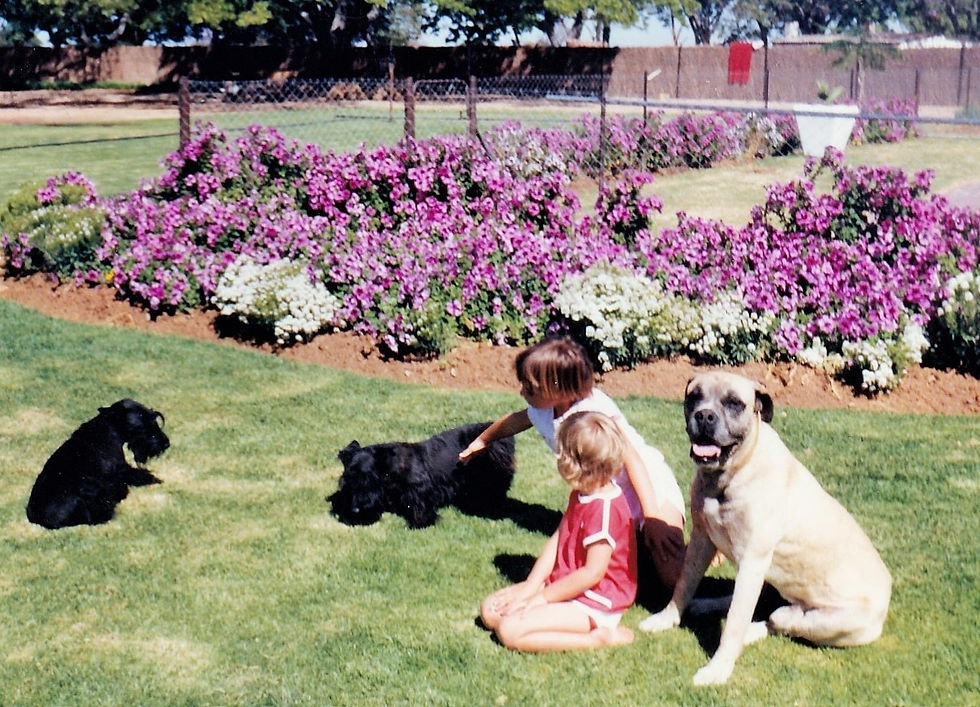
Later in life he had to be put down as he would have fits which made him very aggressive, although he lived to a good age. The other trick he had was when he travelled in the back of my old series one Land Rover, he would leap up and grab any low-hanging tree branches, and I was often to see him hanging from the tree in my rear view mirror, as once he latched onto something he was loath to let it go. When we lost the farm, I had two Scotties and a bull-mastiff named Hoover, because he had a huge appetite, eating his and all the other dogs' food. He was given to me by Daphne Powell as a birthday present. The Scotties were easily re-homed when we left for Zambia, not so Hoover, who remained at our house in Avondale happily protecting the property under the care of our very loyal domestic there, Simon, who said he knew if there was something amiss, as Hoover would bark and only then. He died at a good old age from cancer. I never had cats in Zimbabwe, but we were given one in Zambia by my partner Graham Rae's wife, Bernie, and it turned out to be great, though it was ferocious, semi-feral, and happy to put the fear of death into any dog it came across. We called him ‘The Gook’, as he surely was a terrorist. In Zambia we also had a couple of Jack Russells, great company but demanding of attention. Unfortunately, all died before we left Zambia, the cat with cat AIDS, the female Jack Russel by being run over by our neighbour, and the male by being bitten by a Mozambican cobra. As I say, we decided not to have pets in Portugal, but are, in fact, very happy to board the cat.

I would like to chat a little more about my trip, or rather trips to Sesheke, and also point out my error in a previous blog by saying it was in the South East of Zambia while in fact it is on the opposite side, the South West. Only one person pointed this out, and I am grateful to him, as in my placement I would have also swapped Mozambique for Namibia. Anyway, on arrival at Sesheke I was to see it was very sparsely populated, as was most of the road along the way, with forests most of the way from Brachystegia (Miombo) woodlands, changing to Mopani; I had never seen such a concentration of Mopani before, then into Rhodesian teak, Baikiaea Plurijuga, forests with some Rosewood, a highly sought-after timber for furniture. Rhodesian teak is not true teak but a beautiful dark hardwood originally exploited to supply sleepers for many railway lines in South Africa. It is commonly found in Northwestern Zimbabwe and Southwestern Zambia, extending into Angola, but more recently, the Chinese have devastated it through their exploitation for flooring manufacturing. By the time I got there, I knew it, as many Zimbabweans had it in our large houses, with dining room suites, bartops, and solid doors. It is a very durable hardwood rarely prone to insect attack, and when oiled and polished up is beautiful. Before reaching Sesheke, my companion and guide, Jones Akapelwa, decided we should visit the old sleeper manufacturing sawmills at Mulombezi, some ninety kilometres north off the main road, if you could call it that, through the forests.

As Rhodesian teak only grows in sandy soils, it was lucky we were in my Land Rover, as the road had been ungraded for many years. Although most of it was sand, the vleis were muddy. There were still a number of steam locomotives, as were the steam engines that powered the sawmills. There were numerous abandoned houses; there must have been a large community here during its heyday, although a couple had been taken over by locals. To my surprise, as we drove up, we saw an old railway line that once transported the finished sleepers to the main road some ninety kilometres south. Another thing, over and above the beautiful trees was the phenomenon of the mice’s habitation within the forest itself. In many places, it was like walking on honeycomb as the ground collapsed beneath our footfalls due to the extensive network of mouse paths underground, where they lived and fed on teak seeds. Also of interest to me was the one wide-open grassland Jones told me about as a child; he was in his sixties; it was a river he crossed on his way to school, and hippos had resided in this very spot. So nature changed and weather patterns long before global warming. I think that will do for this week.
Disclaimer: Copyright Peter McSporran. The content in this blog represents my personal views and does not reflect corporate entities.


Comments