


Hope, Chances, Mongu and The Challenges of Green Field Agricultural Start-ups.

I am going to stop mentioning my health for a while for two reasons. The first, and most important, is that I am sure you are all bored with it by now; the second is that every time I mention there is an improvement, there seems to be an evil spirit listening who overturns my view. Equally, the doctors cannot pin down the problem, and in a sort of way I am hoping that the problems will disappear just as they suddenly arrived. As I mentioned in one of my earlier blogs, our school, Keil School, motto was, ‘Persevere in Hope ’. The deputy headmaster, Ian McDonald, known as ‘Wee Aye’ due to his diminutive height and the fact he often said aye as a precursor to some form of punishment, his favourite being the strap. We liked him as we also preferred his form of punishment to detention or natural history, the latter consisting of weeding the lawns or sweeping the extensive drives of leaves, both non-productive tasks meant as punishment by stealing our very limited free time. Anyway, he informed us all that contrary to our motto, hope only worked if accompanied by hard work, which I was to find in later life to be true. So here I am, contradicting him and myself by keeping my spirits up and looking forward with hope that my recent, or rather long-standing, stomach ailments will just disappear. What are the chances? I hope it's better than 50/50.
Now that brings me to chances. Being rather incapacitated to do much physical work in the garden and lying awake at night, it gives me plenty of time to reflect on life and how many times chance intervened and determined its course, successes or failures. Yesterday, Sunday, while playing cards, something I can still do, with John and Margaret Tidey, John informed me he often thought about how chance had brought opportunity into his life and where it would lead. It is true; the problem is you have to have the ability to see that it is a chance with possibilities, not one that, if taken, will bring punishment, failure or even retribution, both in private life or business. I am sure we all have had some of those as well as the good; we would not be who we are without them. Then there are others who live their life on the edge, real chancers as they were known in my day, and were rarely successes. The comedy, ‘Only Fools and Horses,’ portrayed them to a tee; I still enjoy watching them. However you look at it, much of our life is driven by hope, and hopefully taking the right chances, opportunities when we see them. Let's be truthful, life would not be the same without hope and its bedfellow, chance.
Back in 2003 the sponsors of the Sesheke timber enterprise along with Colin Kelly slowly convinced me I should look at it further, and obviously to do so we would require a licence and timber quota from the state, which could only be obtained with the consent, at least in theory, of the local chief at Mwandi, and the king of the Lozi People, the Litunga, the predominate if not only tribe in the Western Zambia, Barotseland, on both sides of the Zambezi. The area was and still is called Barotseland, and the Lozi people see themselves as being separate from central government due to British treaties during colonial times and country boundaries were drawn out on inaccurate maps crossing tribal and cultural lines with little thought. After all, they were overlords of the country; why should they worry about the traditional boundaries of the indigenous peoples? This led, and still does, to many disputes and wars on the African continent. Anyway, while the Lozis feel they are a separate nation, they presently live peacefully under the law and governance of the greater Zambia, which, of interest, is recognised as having more than seventy indigenous tribes. The Lozi people were predominantly fishermen and cattlemen, both abundant and thriving due to the famous Barotseland floodplains, a million hectares, teeming with fish feeding on the nutrients dropped by the cattle during the annual floods, that is inundation, and wonderful grazing in winter when the floods retreated. The perfect cycle of water and nutrients. I was to learn there were a few unique quirks in this province, a couple unique, the first being they hated fences, and you will not come across any agricultural land divided by fences in that province. Many investors thinking of ranching there soon gave up the idea of doing so without fences; there is still an amazing amount of wildlife in this province, much of it migratory, having the second biggest migration next to the Serengeti. Further, the Litunga did not allow Indian traders, as the one-time king, on a visit to Lusaka, decided to buy a shirt in an Indian store and, rather than give a price, the trader said to the Litunga to make him an offer. There and then the king decided he would not allow any traders who did not know the value of their own goods, hence the ban on Asian shopkeepers. I never came across an Asian trader there. Maybe times have changed; there are certainly plenty of Chinese chasing its wealth, whether it's timber or minerals. When I decided to follow up on the timber enterprise, Jones Akapwelwa, now a good friend and a Lozi of high standing, said we should introduce ourselves to the Litungo and his council. I dreaded the thought of this as I knew, from previous experiences in Zambia, the protocols for these meetings are long and can be expensive in both monetary terms and time against the rewards on offer. Rozanne decided she would like to go, having heard about this wonderful and still very underdeveloped part of Zambia along the Angolan border, so we duly set off on the nearly six hundred kilometre drive to Mongu, the main town and residence of the Litunga. More about this next week.

On the farm where I was now residing, it was a race against time to finish the dam and build the curing facilities on four tobacco sections, which had become five with the inclusion of a leased property with a small dam known as Triangle. The mainline would be some eight kilometres long and would require multiple main transformers and step-down transformers for the pivots. At one stage we thought we could hand clear the timber and use much of it for fuel, which we did with some of it, but as time became short in the end we resorted to bulldozers. In subsequent years we learnt that an excavator, both for clearing of timber and anthills, did a much better job without changing the fields into dustbowls of fine soil as the tracks of the crawlers did. We all learn from experience. As I stated earlier, we totally underestimated the cost of flattening the anthills in Zambia, goliaths compared to what we had encountered back in Zimbabwe. Unbeknownst to me, in my search for funding, Graham Rae, who was our designated Managing Director, was also sourcing lines of credit for the farm, mainly for chemicals and fertilisers, which were to surprise me in the following tobacco sales season. Graham can be persuasive. I suppose he did what was best for us to achieve our goals, although the banks would become unhappy at a later date. The pressure of our ambitions and Graham’s management style would lead to a high turnover of managers, but for the first eighteen months most managed to stick it out despite the extended-hour work every day.

Meanwhile, most of our scheme members were also trying hard to complete their curing facilities and get their land cleared and cultivated for their first crop. Two of the first to get up and running were Hans Kotze and Ian McGhee, both taking over farms with cleared land and old barns easily convertible or usable for their first crops, using timber to cure. I thought both would fly, but at a later date, partly due to personality changes at Zambia Leaf Tobacco (ZLT) or rather by Universal Leaf Tobacco (ULA) the holding company with control over all its subsidiaries in Tanzania, Zimbabwe, Zambia and Mozambique, and American owned with its headquarters there, far from the workplace where the African leadership of the company seemed to do what it pleased, much to the detriment of the growers but eventually to their own reputation. As stated earlier, another nightmare arose with the strengthening Rand against the US$, which was the currency of our loans. By December 2003 it had appreciated by over fifty percent against the US$, doubling the cost in US$ terms of our imported inputs, including the main ones: fertilisers and chemicals, and all our capital infrastructure, from curing heat sources to the metal structures for erecting sheds and roofing sheets for the said curing systems. A very stressful time for all, including in our own farming enterprise. Needless to say, despite the many battles with the bank, ULA and even the customs, who were more than happy to declare sheds or at least the materials such as roof sheets and steel structures as being non-agricultural and therefore applying VAT and import duty to them when they should have been duty and VAT-free. Agriculture was meant to be exempt, but try convincing a bureaucrat of that in his search for a bribe to resolve the issue.
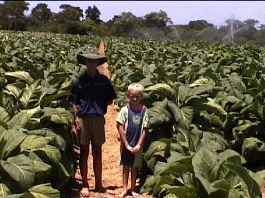
Being a farmer, it is extremely hard to find an ally; everyone from government departments, the banks and even our sponsors from the trade, ULA, wanted to keep their share of the spoils intact despite the possible impact on those expected to pay the loans; the farmer. Local suppliers in Zambia were much more flexible than those, mainly corporates and government departments, all of whom would benefit from a vibrant farming sector, liked to see their money being returned as a priority even at the expense of the business. Needless to say, all the scheme members would get a crop in but found their debt burdens much greater than envisioned, setting our task in running the scheme a real challenge, both mentally and in time. Every day spent with stress.
Disclaimer: Copyright Peter McSporran. The content in this blog represents my personal views and does not reflect corporate entities.


Comments