


Careless or an Accident? Chris Thorne and Flying Adventures.
In my old age, I find I give myself extra, needless work in carrying out simple tasks. That is, instead of getting up to place the piece of paper or rubbish in the bin, I throw it from my place of rest at the time in the direction of the bin, which is a 50/50 call, and then in the event of the almost predictable miss I have to get up walk over and get down on my hands and knees to retrieve the wayward item from under the bed or sofa where it has inconveniently rolled or floated to. When it comes to teabags, apple cores, or banana skins, the wall behind the compost bin invariably needs a wipe-down, as my aim is more often than not off, resulting in a nasty splatter. If not the wall, then the floor, like the dregs of the tea from the cup I put into the dishwasher without emptying it down the sink first. I regret not using the simpler, cleaner method of placing it in the required container or appliance. When I make tea or coffee, I spill it through carelessness, as I do with my soup and yoghurt. It was my father who first pointed out my carelessness to me in my childhood. If I missed the plate with the tomato sauce, spilled my tea, or broke a glass, it was not an accident; it was carelessness. In his mind, accidents were the result of carelessness and could and should be avoided, no matter the circumstances. Now, in my old age, I am the one who mentally rebukes myself for my carelessness, which I in turn blame on my laziness. I now wholeheartedly agree with my father’s assertion; in my youth, I did not. How many of you have the same problem? Rozanne rarely spills and always places stuff in the bin. Are all women like that?

Before I move on to my next topic, Chris Thorne. I thought this week with confirmation of gallstones seeing my doctor this week would be the only process between me and booking an appointment to get them removed. Not so, my good doctor who I have great trust said, your gallstones are small but I am concerned there is something other than gallstones at play here and I want you to go ahead with your colonopscopynext week as planned. Meanwhile here is another handful of pills to help with the pain and try and reduce the other symptons, bloating, constipation, etc. So there we are, but I should say I have had little or no pain for the past three days, the longest since Christmas following my last surgery. So I will be patient, I now swallow more than twenty pills a day for my various ailmants, I hardly need to eat anything else. Unfortinately that is one of the things that is worrying my doctor is my weight loss. Slim and being McSporran are not synoymous.
This week, I picked up Chris Thorne’s memoirs, which were shared with me by the Thorne family as a close friend. Rose and Chris’s daughter, Rosanne inform me they have not built up the courage to read them as yet, as it is still too close to his death last August. I myself have not read it all, but the little I have seen of it is amazingly detailed, and obviously Chris’s recall was excellent right up until his death, unlike his father, who died with dementia. What a life he lived, many of the incidents I knew of, but many occurred before I got to know him properly, really only getting to know him in the last thirty years of his life. For myself, I saw Chris not only as an invaluable partner in our move to Zambia with Agricultural Advisors International (AAI), the company I formed as the vehicle to assist displaced farmers in moving there, but also as a loyal and trusted friend. Chris had been a successful farmer and businessman, operating from a well-run farm in Glendale, where he placed the biggest centre pivot of his time in Zimbabwe, 140 hectares, claiming it worked due to his conservation farming methods, leaving crop residue to reduce the run-off. Chris was well organised, having also set up a number of butcheries in the area as far afield as Umvukwe and was the main instigator of setting up the Mapunga Silo Consortium in Bindura, serving the farmers in Glendale, Bindura, Matepatepa and Shamva, raising the money to build the silos and finance the crops which were to be sold on to the processors, millers and expressors, at the time of optimum price. This was essential now that the grain market had been partially liberated, and at harvest, the processor would take full advantage of farmers who could no longer rely on the Grain Marketing Crop to purchase at an agreed price for all farmers in the country, no matter their location. The further you were from Harare, the more prejudiced you were due to logistical costs and the inability to store all your crop to sell when prices were stronger later in the farming year, as they inevitably were.
Chris was a dedicated family man and he liked nothing better to have his four children close by and his layal wife Rose. The two girls were. Rosanne and Nicky, both going to school at Arundel with my daughters and his sons Marc and Duncan. But I also knew Chris as a very tough guy, in business and life, having been, among other things, during the Rhodesian War of Independence, a Police Reserve Air Wing (PRAW) pilot during the war using his own Cessna 180 (tail dragger) aircraft, which was used as a spotter plane. Chris took it one step further, removing the passenger door and mounting a Browning machine gun operated by a volunteer police reservist. His actions brought him into range from the ground on many occasions, and on one such occasion, he was hit in the chest by a bullet; luckily, he was wearing a flak jacket, with him only suffering a very bad bruise. Sadly, on another occasion, his machine gunner was killed when they came under fire on a similar engagement. This did not deter Chris, who continued the war with a replacement gunner, undeterred by the danger he put himself in by providing overhead cover to those fighting on the ground. His plane, over the war's duration, gained many bullet holes on the fuselage and the wings; luckily, nothing stopped it from flying. Chris was very bright, and despite leaving school after O-Levels successfully attended Gwebi Agricultural College and went on to farm in his own right in the Mkushi Block in Zambia before taking up a farm in Glendale, Rhodesia, which he was forced to leave after being barricaded in his house for days, if not weeks, suffering severe Jambanjis and threats to his family including his son Marc who narrowly escaped death on one occasion. Chris did not take fools lightly, and if he thought you were one, he would tell you so. Yes, he could be confrontational, and this did not always serve his best purpose, but he was not one for compromise. He was exceedingly loyal to those that became his friend, and I was more than happy to be one. Chris and his son Marc built the main cash flow tool we used at AAI, and with him going farming, it remained with the company, which I continued to use until I left Zambia, be it slightly modified.

Chris flew his plane to Zambia and used it to visit farms further afield that might be of interest to our scheme members, making a two-day round-trip by car into a single-day round-trip. A huge benefit, especially when we visited Choma, Kaloma, Mkushi and also Chipata, where Barclays Bank wanted us to look at a property. One of the hairiest trips I had with him was to Mbala. One of the land owners, Griver Sikasote, who had offered us two farms in the Lusaka area, including the one that Graham Douse lost out to a friend of the then CEO of Univeral Leaf Africa (ULA), desperately wanted us to look at a large farm, not any farm, the old Canada Cereal Project farms, in Mbala some 1200 kilometres north of Lusaka by road. You can gather that, given the amount of land Griver had, he was well-connected to the ruling party, having been the CEO of ZESCO, the country's electricity utility. Never had been a farmer, although his wife did have poultry on one. We said it was too far, especially as the only airstrip in the area was a military one, where no private or commercial aircraft were allowed to land. But Griver, through his connection with the then State President Mwanawasa, somehow got permission, and Chris agreed to fly. Not so simple, as there would be no fuel available up there, and we would therefore have to carry the required fuel in drums inside the plane for our return trip. So off we set, Chris and I in the front and Griver, to his credit, squeezed in amongst the fuel drums in the back, made all the more scarier, that despite the overwhelming smell of petrol, Chris smoked all the way. Chris was a heavy smoker and a drinker of whisky. No beer, no cool drinks, his drink of choice and insistence was whisky and water. No matter where we were, including our previous trip to the Canadian Wheat Farms in Tanzania two years previously, Chris would always have a bottle of whisky in his luggage. Once at the Mbala Airbase, we could not understand their paranoia about security, as the only aeroplanes we could see on the base were deteriorating wrecks that had no chance of ever flying again. We found the farms to be excellent, with potential for irrigation, with about 1200 hectares cleared, although the buildings, apart from a dilapidated house and a shed, had long disappeared into the neighbouring villages. We developed a business model, but because of its isolation, there was little interest. This changed some fifteen years later, when, through AgDevCo, we set up Zambia’s first seed potato project with Buya Bamba on this and another farm down the road. It was also the first time I had seen the impressive Lake Tanganyika, home of the giant perch, a fisherman's dream destination, very much untouched in the south, unlike the north, where overfishing was rife.
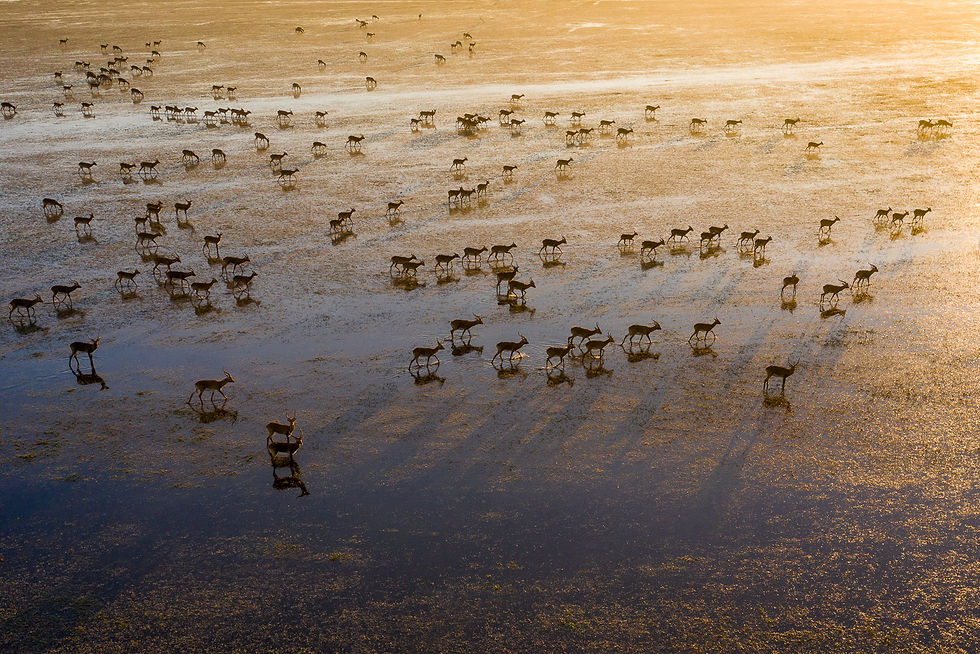
Also, much of the flight there and back was over the amazing Bangweulu Swamps. I had no concept of their size until this trip. They cover some 9,000 km² in a 15,000 klm basin.
Our return flight turned out to be uneventful until, approaching Lusaka Airport long after dark, as we began our approach, a large aircraft suddenly appeared on our starboard side, crossing only some fifty metres in front of us. Boy, did the radio start going crazy, not directed to us luckily, but at the unknown plane with its pilot being directed on landing, to report to the control tower immediately. We heard that disciplinary action was taken, but to this day, I do not know the names of the crew.
Chris got terribly upset about the way ULA treated our farmers, or rather tried to bully them as our main sponsor, and eventually decided to return to farming. As all tough business men, they seem to not only have their share of friends but also they get some enemies and the same can be said of Chris, and unfortunately he fell out with ULA and finally two Zambian businessmen would dishonestly take his farm in Zambia, with the added assistance of a crooked justice and banking system, thus dislodging Chris and Rose from their very valuable farm near Lusaka Airport. The attraction was that it was earmarked for urban housing. The farm was worth several million US$ more than he owed to the bank.
“Where there is a lot of money to be made, there is greed, and where there is greed, there is sure to be crooks.” - Peter McSporran
Crooks, like vultures, are always looking for opportunity. Sadly, Chris died last August from cancer, a quick but painful death which took us all by surprise, having established himself in farming once again on a portion of Rose’s old family farm in Kabwe. He had become a successful poultry farmer. Rose, as of now, continues with the business while she decides what is best for her. In his memoirs, Chris typically writes a list of those who influenced his life called ‘the good, the bad and the ugly.’ I was relieved to see my name on the good list. Best I do not mention any on the bad-and-ugly list.
Disclaimer: Copyright Peter McSporran. The content in this blog represents my personal views and does not reflect corporate entities.


This article offers practical advice for anyone who spends time driving around Milford. Exploring Towing Service Milford CT can help motorists become more familiar with roadside support before it is ever needed.
I appreciate how this post highlights the importance of using the right towing equipment. Choosing Flatbed Towing Services Near Me is often the safest solution for protecting vehicles during transport while providing drivers with extra peace of mind.