


A Weekend Away, Short Medical Update. The Rise of The ‘Sorry Bean’ and A Story of Two Countries’ Maize.

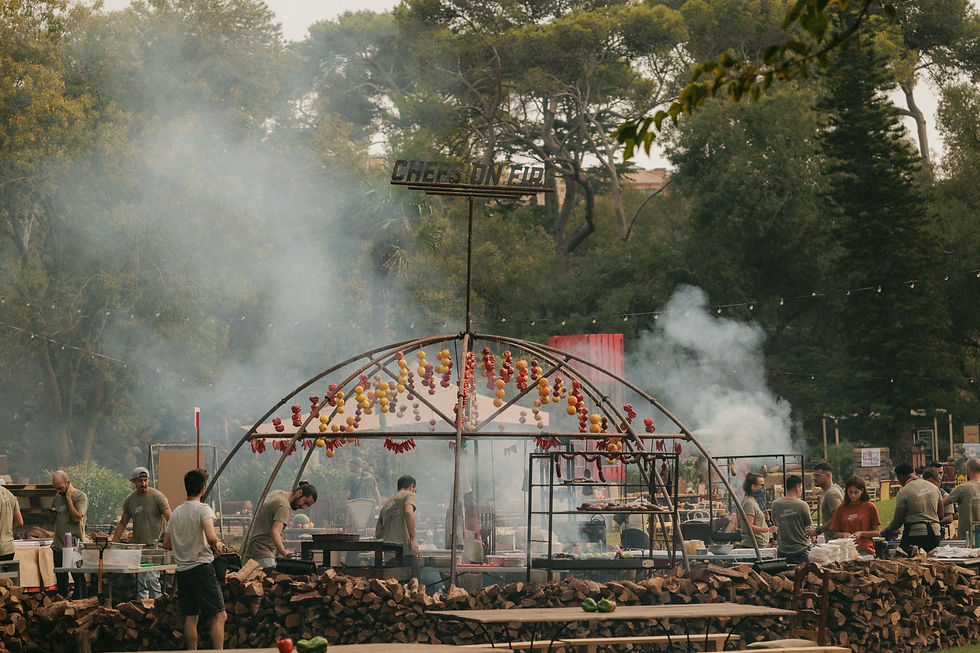
This weekend, my daughter Storm and her long-time partner, Duncan, invited us, along with a couple of her friends, to the cooking event 'Chefs on Fire’ in Cascais, which is west of Lisbon and some 200 kilometres south of us. My first trip away for a weekend since the onslaught of my regular stomach pain, and marking my health’s improvement in allowing me to take the risk of leaving home for a couple of days. We had a lovely time, and although some 60 chefs were cooking on the barbecue, the food was gourmet, served in tapas-sized portions that surprisingly filled us quickly. It also built up a huge reservoir of wind in my stomach, which I sometimes released involuntarily at embarrassing moments. At least only discomfort, no pain. The standard entry ticket offered five dishes, although the amount of extras you could buy was unlimited. I know my regular readers will be asking how he could eat exotic food on your FOD-Map diet. Easy, as midweek I met with another gastro specialist who reviewed all my tests and informed me that my problem was not diet-related and that diet would not fix it. Her words were, “Peter, you must understand you are a survivor who has had numerous serious surgeries in your intestines and you have abrasions (scar tissue) and no pill or medication is going to fix it. You will have to learn to live with it.” I said to her the latter was much easier to say than to do. She agreed but said I had to adopt a mindset to deal with it. She further informed me I must make sure my bowels move every day. I have suffered from chronic constipation since my surgeries and already take laxatives to relieve it, but she said I must take these every day, along with a fibre supplement, while also instructing me to drink up to three litres of water a day. A further complication for me is that I suffer from incontinence from my prostate surgery. She did say some foods may be an issue, but I need to identify them as I go along rather than the blanket FOD-Map recommendations. Luckily, for the first time in a long time, I got through the weekend without too much discomfort. I just have to sync myself to living with the pain and do my relieving exercises when I get the now-established warning signs that pain is on its way. As I have said in recent blogs, it is not as bad as it was at the beginning, although it is more frequent; let's hope it improves further. Oh, and I have to eat more protein to get back some muscle; those that remember me from days gone by will think that fat bugger is being told to eat; I do not believe that? Well, things have changed in many ways.
Despite this, we cut our trip short by a day, not because of me but because of a warning light in the bloody car. It was an emissions warning, so we could still run the car until the light started flashing or the system reduced performance. On Saturday, unbeknownst to us when we booked, we bumped into our friends the Tideys at the 'Chefs on Fire’ event, and they offered to escort us home in case of breakdown. Rozanne was dreading getting stuck at the side of the motorway with a sick husband, especially in the hot weather we are having, 37°C yesterday. They were coming home on Sunday, and we thought rather be safe, than sorry we left a day early. Luckily, the car got us home, with us dropping it off at the local garage, Celso’s, without telling him we had dropped it leaving the key in his letter box at his home only for him to phone that evening to ask what was the problem and when I told him he said he would go and attend to it immediately, that being a Sunday evening no less.
When I first got to Rhodesia in 1972 and started working for Hamish Smith at Umzururu Farm in Nyabira, he, like many maize farmers, had only just begun growing soya beans. Rhodesia very much relied on cottonseed oil in those days for its vegetable oil, along with cottonseed cake as the protein component for the beef and dairy rations. The Smiths used to stockpile enough cottonseed for a year for their dairy herd. Anyway, it was not long before all of us growing the then-only local variety Oribi started calling soya beans ‘sorry beans’, as in those days yields were hard to achieve, and, along with the lack of knowledge in growing the crop, it was difficult to reach 1 tonne per hectare. On Umzururu, we averaged about 850 kilograms per hectare across the whole crop, but despite this being sub-economical, we persisted for two reasons: rotation to enable broadleaf weed control in what had been monocropped lands, and nitrogen fixation in the soil. Rex Tattersfield was the Government soybean breeder, and within five years we began to see significant yield improvements with his improved varieties. This increased farmers' interest, along with the 2% loans available for installing irrigation to produce winter wheat and soya, fitting well into a double-crop rotation. Most of the country's wheat needs had to be imported, which was difficult during sanctions. It was not long before commercial cotton farmers who had access to water also began switching to a wheat-soybean rotation, with both crops trading at near-import-parity prices, as we were still a long way from self-sufficiency in these commodities in Rhodesia. In fact, we tobacco farmers could also get these soft loans if we grew wheat; hence my decision to grow groundnuts and wheat in my tobacco rotation, much to the disgust of the traditional tobacco grower who said you could only grow quality tobacco under rainfed conditions, following at least three years of Rhodes grass rotation, a view also shared by the tobacco buyers, who discounted our price on irrigated crops. Despite this, the early-planted tobacco yields were so good that the discount was not large enough to discourage us. Within ten years, we learnt how to grow high-quality tobacco under irrigation using suitable varieties developed specifically for this purpose. Further, the Chinese preferred our lemon-coloured unblemished leaf to the mature, flavoured leaf demanded by Europe. By then the anti-smoking lobby was affecting sales to Europe anyway.

“Agriculture, agricultural scientists and those that practice it are some of the most adaptable and innovative people in the world. After all, we see other industries come and go, but as yet there is no viable alternative for farmer-grown food.” - Peter McSporran
Getting back to the ‘sorry bean’ story, come 1980 the new government after independence said food crops, specifically maize, should be grown by smallholders, with the Grain Marketing Board offering prices too low for commercial production to be viable, along with a wish for them to grow cotton as a cash crop due to its high labour input if grown on commercial farms. Their costs were low as the smallholders and their families’ labour input was seen as free, with no thought that perhaps this was a form of slavery.
“In Africa it has been a long term fallacy believed by governments and NGOs that smallholders can grow crops cheaper and of better quality as they are planted, weeded and harvested by hand. This is only true as the cost of their labour is never taken into account in their growing costs.” - Peter McSporran
So there was a further swing into soya beans on commercial farms at the expense of cotton, and the obvious crops to turn to were high-input, high-return crops, such as wheat, soya and plantation crops. Livestock farmers continued to grow maize as stockfeed, as did broadacre farmers suited to growing maize under mechanisation. That is in good, deep, rich, high-clay-content soils ensuring high fertility and water retention.

Now I get to what triggered today's subject, and that was an announcement by HH (Zambia’s President) that Zambia had produced 4.9 million tonnes of maize this year; meanwhile, despite what the Zimbabwean government says, that country probably produced less than 1 million tonnes in total, most of it not bound for sale and probably 2 million tonnes below annual consumption. Back in Rhodesia, when I first arrived, there were maize depots in every farming community, even in areas like Darwendale and Nyabira, traditional tobacco-growing areas. My closest one was at Wellesley Siding, at the end of our farm road, where maize, as in most of the country, was stored in 90-kilogram bags in stacks. Each depot's stackmaster took great pride in his respective stack. Other depots close by were in Maryland, and when I bought my Mazowe farm at Passaford, by the railway siding. They were always close enough for a farmer to deliver by tractor and trailer, or if serving smallholders by ox-cart.
They may have been seen by many as a colonial government in many eyes, but the Rhodesian Government recognised the need for ready access to market to circumvent the cost of logistics and storage losses to the smallholder farmer. Without easy access to market, the smallholder is at the mercy of the so called aggregators, better described as speculators, benefitting from the challenges of the smallholder in storing and transporting their crops.
No matter where the maize was, it was always in 91kilogram hessian bags. When I first arrived in Rhodesia, I was amazed to see 50-kilogram men carrying 91-kilo bags on their heads up those stacks without the use of grain elevators. Not a once-off, throughout the working day. After independence, the 91-kilogram hessian bags made way for the 50-kilogram polypropylene bags. The weight was governed by the World Labour Organisation. These slippery bags, prone to sun damage and non-biodegradable, often led to stack slippage and, if damp, with an inability to breathe, soon causing stack burn and rot.

The maize centres of production, red soils and good rainfall, had silos, and I remember touring the country as chairman of The Commercial Oilseeds Producers Association (COPA) in 1987 along with Dick Bylo, a Karoi farmer and chairman of the Grain Producers Association, and Oliver Newton, from Bindura and Chairman of the Cereal Producers (wheat and barley), checking on stocks at all the GMB depots. At that time we were producing 130,000 tonnes of soya beans, over 3 million tonnes of maize with over 2 million tonnes of strategic supply in stock at the GMB storage facilities, which was both stacks and silos. Dick was happy to tell Oliver and me that we were representing small-volume producers compared to his commodity. Maize was still king. Many may not know this, but white maize was initially grown in Rhodesia for the Scottish whiskey distilling industry; hence white became the maize of choice for the staple diet rather than yellow.
So the Zambia maize production figures triggered my memories, and I am sad to say forty years on, Zimbabwe is producing less than half the soya crop from back then when it was still in its infancy, wheat production, I have no idea, as the government talks about 600,000 tonnes, which the existing irrigation infrastructure in total, let alone that lying idle, would be incapable of producing. Maybe half to a third of their inflated figure, same as their stated maize figures. Despite claims of an improved harvest, I am reliably told there are only 300,000 tonnes of grain stored at the GMB, this being at the end of harvest. Of this, only 150,000 tonnes is maize, probably one month's supply for the country's current population. The rest is other cereals such as wheat.
“Whether the forecast El Niño will bring the predicted drought or not, Zimbabwe at present has little more than 1 month's supply, let alone 18 months if there is a drought. The issue is further complicated by unreliable figures, driven by the government's boasts and lies. Hopefully there is more than thought. ” - Peter McSporran
When we went to Zambia in 2001, the country was importing maize, with domestic production below 1 million tonnes. Further, much of the so-called strategic reserve was a fictitious paper number due to corruption and theft and much of the remainder unfit for human consumption due to insect infestation and rot. Now, some twenty-five years later, it claims it has 4.9 million tonnes of production, with 3.5 million tonnes the target for strategic reserve. In fact, a single export currently underway is 540,000 tonnes to Kenya. How things have changed. It was not only the Zimbabwean farmers moving north but also quite a number of South Africans who, along with the surviving Zambian commercial farmers, created the economies of scale to attract the required service industries, especially the banks. Further, the banks could not just be seen as only lending to foreigners, so Zambian farmers, for the first time in many years, also started to get access to credit at reasonable rates. In the early 2000s, that awoke Zambia’s agriculture, while being a catalyst, it was also the technology, genetic seed material and service industries that followed them; importantly for maize and soya production, the massive increase in the use of irrigation to produce wheat, and supplement maize in summer and soya provided food security especially in years of deficit rainfall. Maize yields improved immensely with the introduction of hybrids, despite NGOs strongly arguing that open-pollinated varieties were best for smallholders. Soya bean and wheat yields soon surpassed Zimbabwean yields. Of furthe interest, Zambia now produces three times as much soya than Zimbabwe ever did in one year. I was happy to be a small part of that transition. Very importantly, the Government of that country welcomed and supported commercial farmers, especially in their marketing and access to market and encouraged production. One of the pillars for this in commercial agriculture was the security of land tenure, no surprise there.
To close off, I will finish with another anecdote. When I moved to Zambia, I was on the Seed Co. of Zimbabwe’s board, and I told the board members in one of the last meetings that I believed Zambia would become the production hub for the region. I am sure some will remember that day, as Brian Black, Rob Davenport, John Long and Pat Rooney were on the board and are still around. They laughed then, but this year Zimbabwe produced only 50,000 tonnes of seed maize, not even enough for its own needs, while Zambia produced around 180,000 tonnes, most of which was for export to the region and East Africa. That leaves us with something to think about, and importantly, an idea of where Zimbabwe should have been were it not for Mugabe and his cronies destroying the nation’s agriculture.
Disclaimer: Copyright Peter McSporran. The content in this blog represents my personal views and does not reflect corporate entities.


Comments